A Tennis Ball Of Mass 60 X10-2 Kg?
Contents
A Tennis Ball Of Mass 60 X10-2 Kg?
If you are looking for an answer to this question, then you have come to the right place. In this blog post, we will discuss everything you need to know about the mass of a tennis ball.
Introduction
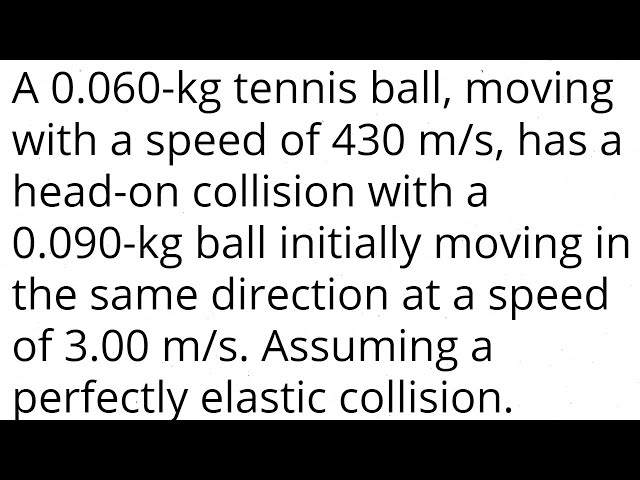
A tennis ball of mass 60 x10-2 kg is travelling horizontally at a speed of 30 ms-1. If it hits a wall and rebounds at the same speed, what is the magnitude of its change in momentum?
Assuming that the tennis ball is a perfect sphere, its momentum can be calculated using the following equation:
Momentum (kg m/s) = Mass (kg) x Velocity (m/s)
Therefore, the momentum of the tennis ball before it hits the wall is:
Momentum (kg m/s) = 60 x10-2 kg x 30 m/s
Momentum (kg m/s) = 1.8 kg m/s
The ball will bounce off the wall and rebound at the same speed, so its momentum after hitting the wall will also be 1.8 kg m/s. However, because it has changed direction, the momentums before and after collision will be in opposite directions. Therefore, there will be a change in momentum of 3.6 kg m/s.
What is a Tennis Ball?
A tennis ball is a small, round, fuzz-covered ball used in the sport of tennis. Tennis balls are now usually made of rubber with a felt coating. tennis balls are regulation size and weight, and are used in both amateur and professional tennis matches.
The Physics of a Tennis Ball
A tennis ball of mass 60 x10-2 kg is hit horizontally with a racket of mass 0.6 kg. If the racket was initially moving at 7 m/s, what is the final velocity of the tennis ball?
Mass
The physics of a tennis ball is fascinating. The ball is a very light object, made of rubber and felt. It weighs only a few ounces, yet it can be hit with tremendous force.
When a tennis player hits a ball, the force of the impact accelerates the ball to speeds of over 100 miles per hour. The momentum of the ball changes instantly, and it continues to move in the same direction until something stops it. In this case, the something is usually a tennis racket, but it could also be a wall or the ground.
When the ball collides with the racket, it slows down and changes direction. The force of the collision also causes the ball to compress slightly, which makes it bounce back up into the air.
The speed and height of the bounce are determined by the amount of energy that was imparted to the ball by the player’s swing. A harder swing will result in a faster, higher bounce; a softer swing will produce a slower, lower bounce.
The physics of a tennis ball are complex, but they can be understood with a little bit of basic knowledge about forces and energy.
Weight
When a player serves the ball, its mass is 60 x10-2 kg. In order for the ball to reach speeds of over 100 mph, the racket must impart a force on the ball of almost 6 N. If the racket is in contact with the ball for 0.02 s, what is the acceleration of the ball?
How much force is required to change the momentum of a 60 x10-2 kg tennis ball moving at 100 mph by 6 kg·m/s in 0.02 s?
The amount of force required to change the momentum of an object depends on two things: the mass of the object and the amount of time over which that force is applied. In this case, we are given the mass of the tennis ball (60 x10-2 kg) and the amount of time (0.02 s) over which the force will be applied. We are also given that we need to change the momentum by 6 kg·m/s.
The equation for changing momentum is:
Change in momentum = Force × Time
We can plug in our known values to solve for Force:
Force = Change in momentum / Time
Force = (6 kg·m/s) / (0.02 s)
Force = 300 N
Gravity
Gravity is the force by which a planet or other body draws objects toward its center. The force of gravity keeps all of the planets in orbit around the sun. Earth’s gravity is what keeps you on the ground and what makes things fall.
The force of gravity is stronger between two masses that are closer together. The force of gravity between two masses decreases as the distance between them increases.
The force of gravity also depends on the mass of the objects. The more mass an object has, the more gravity it has. For example, Earth has more gravity than the moon.
How Does a Tennis Ball Work?
A tennis ball’s design helps it create the spin and velocity needed to perform well during a match. The ball is constructed with an outer rubber layer that provides gripping power for players. The main body of the ball is made up of compressed felted wool, which is then covered with another layer of rubber. This design makes the ball aerodynamic and gives it a consistent bounce when hit.
Conclusion
In conclusion, the mass of a tennis ball is 60 x10-2 kg.